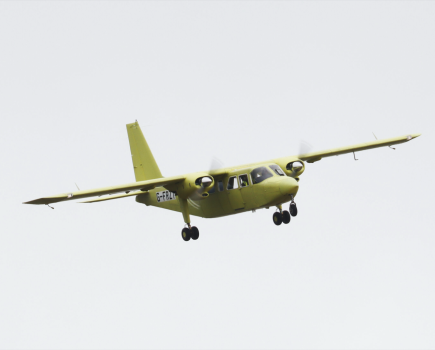
ABOVE: The Turbinetruck is an autonomous cargo helicopter that combines Sikorsky’s ‘Matrix’ autonomy system with the Robinson R66 airframe
The United States Marine Corps recently awarded a $15.5m contract to Sikorsky for the Medium Aerial Resupply Vehicle – Expeditionary Logistics (MARV-EL) Increment 2 programme. The machine selected for the contract is the R66 Turbinetruck, an autonomous cargo helicopter commercially developed by Sikorsky and Robinson Unmanned that combines Sikorsky’s proven ‘Matrix’ autonomy system with the rugged R66 airframe from Robinson Helicopter Company to provide flexible, affordable and rapid combat deployment.
The ability to deliver ammunition, medical supplies and other essential equipment at the point of need – regardless of terrain, weather, or enemy threat – is critical to the US Marine Corps and the MARV-EL programme fills a capability gap between small tactical drones and large strategic airlifters, delivering a reliable ‘middleweight’ uncrewed logistics platform capable of operating from austere forward operating bases, ship decks or unimproved landing zones. The Turbinetruck will support missions when ground or crewed aviation assets are unavailable and help keep personnel out of danger in high-risk scenarios.
The ‘Matrix’ autonomy system plays a vital role for the R66 Turbinetruck and will leverage similar features to Sikorsky’s new fully autonomous S-70UAS U-Hawk helicopter. Rich Benton, vice president and general manager of Sikorsky, commented, “as we expand the Matrix family, we also extend the reach of uncrewed solutions for both civil and military customers. The commercially developed Turbinetruck is simple, economical and re-configurable; ideal for high-risk, hard-to-reach environments where keeping personnel out of harm’s way is essential.”
The MARV-EL programme is the middleweight capability responding to a gap within the Unmanned Logistics System – Air (ULS-A) programme. MARV-EL requires an uncrewed aircraft that can carry a payload between 590kg and 1135kg over a combat radius of 100nm, operating through a common digital handheld device. Similar to the U-Hawk helicopter, the operator enters the mission objectives into a digital tablet. The system then automatically creates a flight plan, using sensors and algorithms to guide the aircraft safely to the target location.
PHOTO: SIKORSKY