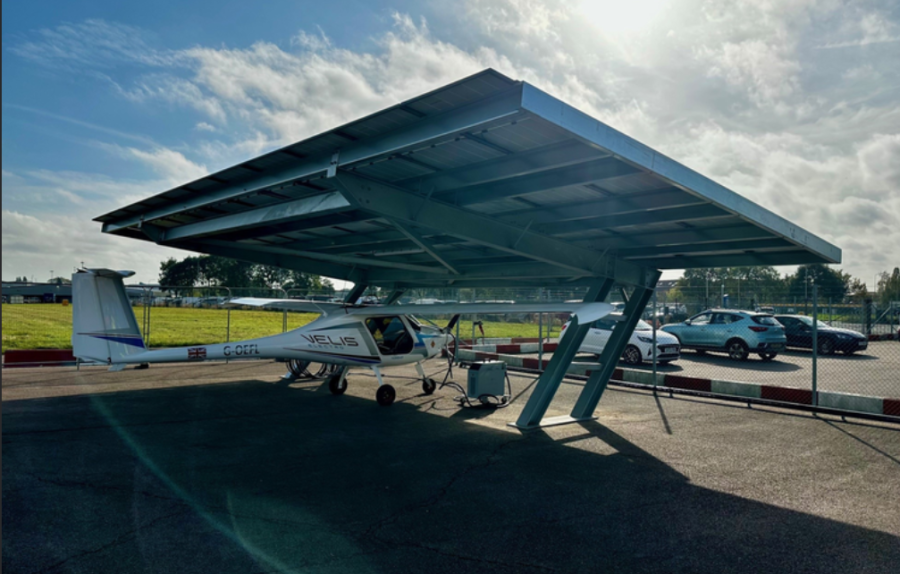
ABOVE: The solar charging canopy will be instrumental in powering SaxonAir’s Pipistrel Velis Electro whilst doubling up as a covered parking space.
Saxon Air has completed the installation of what it calls a ‘pioneering electric charging point’ at its Business Aviation Centre in Norwich, believed to be the first of its kind at a UK regional airport, with the purpose-built infrastructure featuring a solar energy array specifically tailored for electric aircraft.
Covering nearly 86 square metres, the 18kWp solar array includes 44 solar panels mounted on a steel frame, estimated to generate around 18,156 kWh of energy per year – enough to avoid 3,445 kg of CO2 emissions annually.
Designed and built by solar photovoltaic specialists RenEnergy, the new charging point complements existing clean energy capabilities developed in a previous collaboration between the two companies. ‘This setup now generates sustainable power for multiple operational needs at Saxon Air,’ clarified the charter provider, which also includes the electric Pipistrel Velis Electro in its fleet for training purposes. By enabling ‘fast and efficient charging for Saxon Air’s electric fleet,’ the new charger will prove key in ‘significantly reducing the dependency on grid power’.
CEO of Saxon Air Alex Durand confirmed that the installation of the aircraft solar charging canopy will get the company closer to energy self-sufficiency targets, whilst also showcasing electric aviation to a wider audience. “We now have a standalone location for energy self-sufficient electric aircraft operations, and now very much part of normal airport operations,” he added.
“This project is a fantastic example of how innovative renewable technology can be adapted to meet the needs of modern aviation,” explained Managing Director of RenEnergy Damian Baker, who concluded: “We look forward to seeing the benefits this will bring to the sector”.
Saxon Air hopes that its dedicated electric aircraft charging point will help support its sustainability achievement as the lowest-emission flight training centre in England, with an ambition of achieving net-zero carbon emissions by 2030.
IMAGE: SAXON AIR