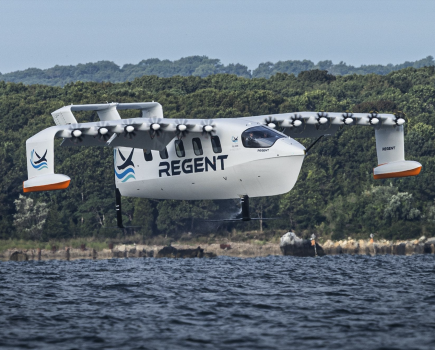
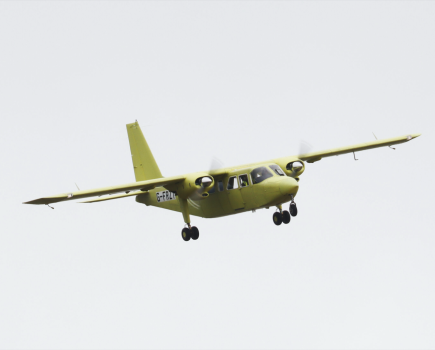
ABOVE: CAP 3038 V1 seeks to pave the way for the routine integration of drones with other traffic.
The Civil Aviation Authority has revealed a plan to enable the regular and routine use of drones in BVLOS (Beyond Visual Line Of Sight) applications from 2027, with its new roadmap set to ‘evolve with industry’ to fully understand the challenges of ‘integrating these operations into the UK’s airspace’.
Initial integrated BVLOS operations will be demonstrated within Temporary Reserved Area (TRA) sandboxes by the ed of the year, offering a ‘test and evaluation’ capability to ‘inform [the CAA’s] understanding of safe operational use and integration with other airspace users’. This will then ‘evolve into the demonstration phase, creating areas of airspace where UAS [Uncrewed Aircraft Systems] are able to able to operate together and with other airspace users,’ explains the regulator.
The CAA expects that ‘the demand for routine UAS operations will increase rapidly in the coming years’, and as such, is taking steps to enable their safe integration – with CAA BVLOS activities ‘intrinsically interconnected with and dependent on the Airspace Modernisation Strategy,’ covering the development and modernisation of UK airspace up to 2040’.
Recent pilot projects have involved the delivery of medical supplies and products by BVLOS drones – including the on-demand transportation of urgent NHS blood samples between London’s Guy’s and St Thomas’ hospitals, and the delivery of chemotherapy drugs to the Isle of Wight. Both of these studies required special permission to operate, something the CAA’s plan hopes to negate.
The CAA also added that ‘integrated BVLOS operations within a collaborative surveillance environment’ is the ‘first step on the path towards the integration of BVLOS operations with other aircraft, both inside and outside controlled airspace’. Although this ‘cooperative surveillance mandate’ is not necessarily a requirement for a transponder, it is likely to be for ADS-B, or any other ‘emerging technology’ that can act in a similar way.
Citing the potential drones have to “transform our lives,” Sophie O’Sullivan, Programme Director for Future of Flight at the CAA, commented: “It is vital that we create the right rules and regulations that current and new airspace users are all happy with while maintaining the highest safety standards”.
The CAA concluded that BVLOS drone operations are “crucial for expanding the capabilities of drones and unlocking innovation,” with the regulator and industry “working ever more closely to maximise the economic and social benefits of the use of drones in the UK”.
IMAGE: UK CAA